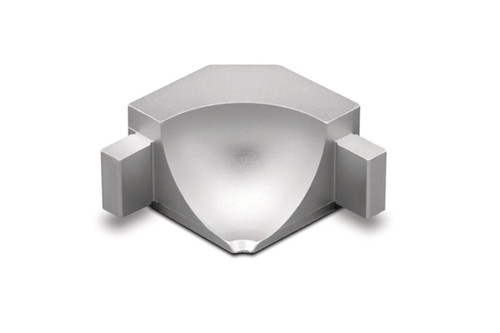
Description
Overview
DILEX-AHKA creates a cove where a newly tiled wall meets an already finished floor. The single anchoring leg embeds with the wall tile, while the adjoining channel can be bonded to the existing surface. This makes AHKA useful when the floor will stay in place during wall renovation.
Features
- Designed for transitions to previously finished floors.
- 3/8-inch cove radius creates a cleanable wall/floor junction.
- Dovetailed channel accepts the bonding material specified for the surface.
- Matching handed end caps and corners finish the run.
What's Included
- One DILEX-AHKA cove profile, 8 ft. 2-1/2 in., in the selected height and finish
Specifications
- Length: 8 ft. 2-1/2 in. (2.5 m)
- Cove radius: 3/8 in. (10 mm)
- Listed heights: 5/16, 3/8, or 1/2 in.
- Material: Aluminum with selected finish
- Installation: Anchoring leg in wall-tile mortar; channel bonded to finished surface
- Available size: 5/16" / 3/8" / 1/2"
- Available color: Bronze (TSOB) / Brushed Chrome (ACGB) / Brushed Nickel (ATGB) / Dark Anthracite (TSDA) / Ivory (TSI) / Light Anthracite (TSLA) / Pewter (TSG) / Rustic Brown (TSR) / Satin Anodized (AE) / Satin Nickel (AT) / Stone Grey (TSSG)
Applications
Use when adding or replacing tiled walls beside an existing finished floor, including appropriate kitchen and bathroom cove details.
Plan Your Installation
- Plan the wall-to-finished-surface junction before setting wall tile; AHKA’s anchoring leg goes into the wall-tile mortar while its channel bonds to the finished surface.
- Select the height for the wall-tile assembly and coordinate the 10 mm cove radius and finish.
- Count left/right terminations and inside/outside turns so the corresponding AHKA fittings are on hand.
- Select the bonding material for the surface and applicable detail; Schluter identifies KERDI-FIX, epoxy, silicone or thin-set in those details.
Common Planning Questions
Is this installed like an AHK profile with the same finish?
Follow the AHKA installation detail. Its wall anchoring and finished-surface connection are the defining selection points.
Do I need handed end caps?
AHKA end-cap selections are left or right, so identify each exposed end from the actual layout.